Africa lost more forest than any other continent in the decade to 2020, according to the FAO's Global Forest Resources Assessment, with a net loss of roughly 3.9 million hectares a year. The pressure is not spread evenly. It is concentrated in a few belts, driven by a small set of causes, and answered by a different mix of tools in each. This guide explains where deforestation in Africa is happening, what drives it, and how carbon finance fits alongside other responses.
Where Forest Loss Is Concentrated
Africa's forests range from the humid rainforests of the Congo Basin, the second-largest tropical rainforest after the Amazon, to the dry Miombo woodlands of southern and eastern Africa and the forest and mangrove belts of West Africa. Loss is not uniform across them. Dry woodlands often lose cover through gradual thinning for fuel and farmland, while humid forests tend to lose cover where roads, settlements and plantations open up previously remote areas. West Africa has already lost much of its original forest, so the remaining patches are small and under steady pressure.
The Main Drivers
Most forest loss in Africa starts with agriculture. Smallholder families clear land to grow food, and as populations grow and soils lose fertility, the cleared area grows. Commercial farming for crops such as cocoa, palm oil and other export commodities adds further pressure in some countries. This pattern is different from parts of Latin America, where large-scale ranching and soy drive much of the clearing.
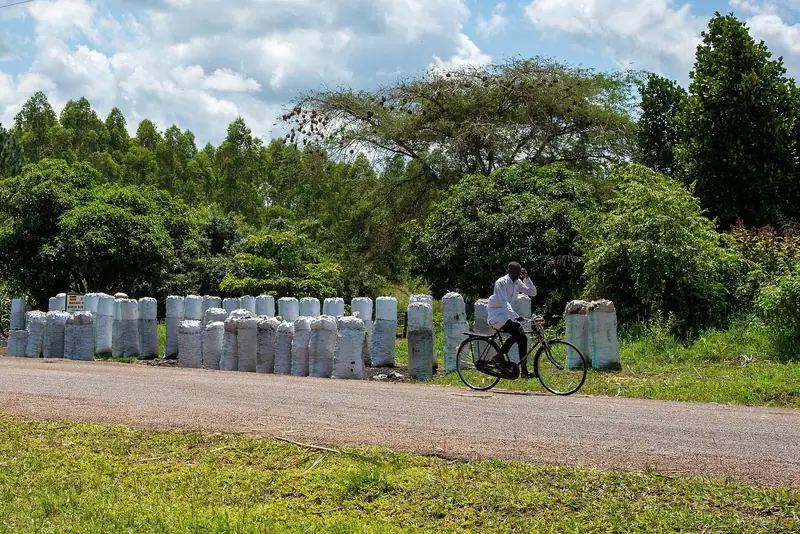
Wood energy is the second major cause. Millions of households rely on firewood and charcoal for cooking, and charcoal production for growing cities removes trees around urban centres, often well beyond what the forest can regrow. Our guide to clean cooking carbon credits explains how cleaner stoves can reduce that demand.
Logging, mining and infrastructure complete the picture. Selective logging, legal or illegal, degrades forest without clearing it entirely, and new roads and mining sites make it easier for farmers and loggers to reach intact areas. Weak land tenure underlies many of these problems, because people who do not hold secure rights have little reason to invest in keeping trees standing.
Deforestation and Degradation Are Not the Same
Deforestation means forest is converted to another land use. Degradation means the forest remains but loses carbon, biodiversity and structure, for instance through repeated charcoal cutting or selective logging. Degradation is harder to see from satellites and is often undercounted, yet it can release large amounts of carbon over time and is frequently the first step towards full clearing. Any serious response has to address both.
What Works to Slow Forest Loss
No single tool is enough. The measures with the best record tend to work together.
- Secure land and forest rights. Communities with clear rights have a stronger incentive and a legal basis to protect forest.
- Better farming on existing land. Agroforestry and improved practices can raise yields without new clearing. See our explainer on agroforestry and smallholder carbon credits.
- Cleaner cooking and sustainable wood energy. Reducing demand for charcoal and firewood eases pressure near towns and cities.
- Enforcement and monitoring. Satellite alerts and ranger patrols help, but only where governments and local institutions can act on them.
- Finance for standing forest. Payments linked to verified results can make protection more attractive than clearing.
Where Carbon Finance Fits
Carbon finance is one of the few sources of money that rewards keeping a forest standing. Under REDD+, projects and national programmes are paid for verified reductions in emissions from deforestation and degradation compared with a credible baseline. Our guide to REDD+ forest protection in Africa sets out how that works and what separates a robust project from a weak one. Carbon income is not a complete answer on its own: it works best when it supports the tenure, farming and energy measures above, and when benefits reach the people who live next to the forest, as described in our piece on community benefit sharing.
Questions to Ask About Any Forest Project
- Which drivers of loss does it address in this specific place?
- How was the baseline set, and is it based on local evidence?
- Does it deal with leakage, where clearing simply moves to neighbouring land?
- Who holds the land rights, and was consent recorded?
- Which registry lists the credits, and what is the buffer for reversals?
Frequently Asked Questions
What is the main cause of deforestation in Africa?
Expansion of smallholder and commercial agriculture is the largest single cause, followed by demand for firewood and charcoal. Logging, mining and road building add to the pressure and open up new areas.
Is deforestation in Africa getting worse?
The FAO reported the highest net forest loss of any continent in 2010 to 2020. Trends vary by country and forest type, so national and local data should be checked rather than relying on a continental average.
Can carbon credits stop deforestation on their own?
No. Carbon income can make protection financially attractive, but it works best alongside secure land rights, better farming and cleaner energy, and it depends on honest baselines and independent verification.