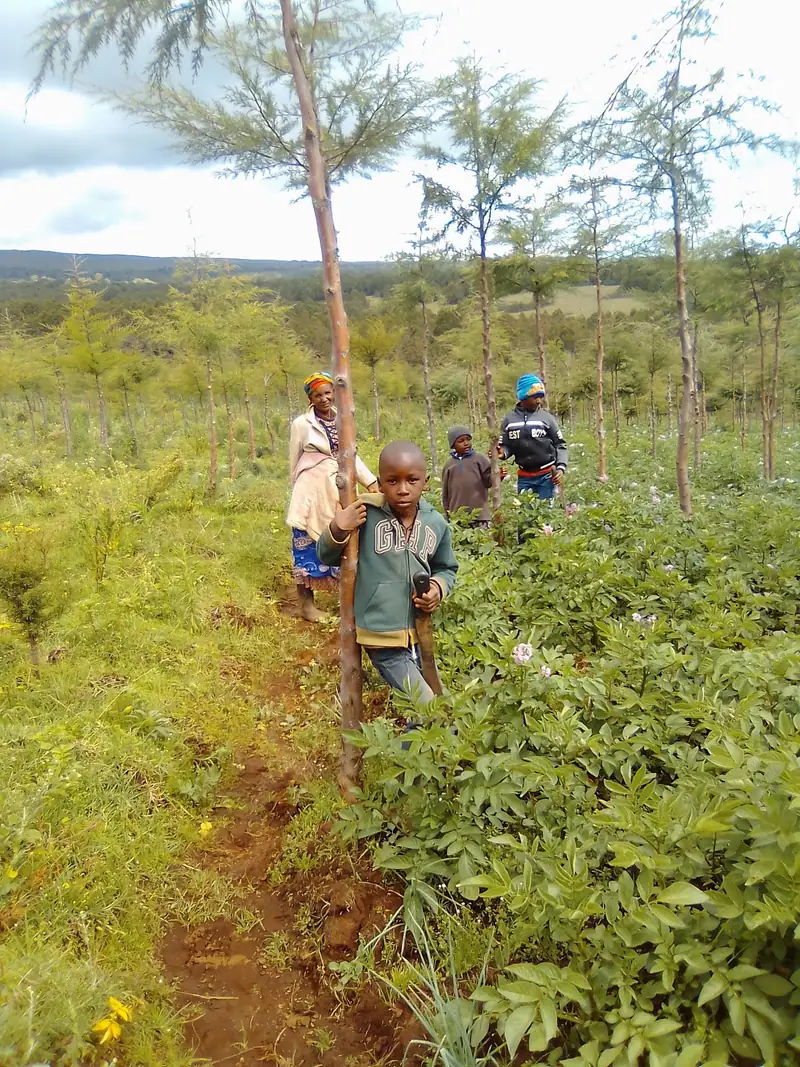
Agroforestry, growing trees alongside crops and livestock, is one of the most common land uses in Africa. Farmers have managed shade trees, fruit trees and fodder trees for generations. Carbon projects now try to count the carbon stored in those trees and sell it as credits. Doing that fairly for a smallholder with a few hectares is harder than doing it for a forest concession, and buyers are right to ask how the numbers are produced.
What Counts as Agroforestry Carbon
Agroforestry covers several systems: trees planted along field boundaries, fruit or timber trees grown among maize or coffee, improved fallows, and woodlots established on degraded farmland. Each one stores carbon in woody biomass and in the soil, although the soil component is harder to measure and is often left out of credit calculations. A credit can only be issued for carbon that a project adds beyond what would have happened without it, so the starting point matters as much as the trees themselves.
How the Carbon Is Measured
Most farm-level projects do not weigh trees. They measure stem diameter, and in some cases height and wood density, then apply allometric equations: statistical relationships that estimate above-ground biomass from those measurements. The equations are calibrated on destructive harvests of similar species in similar climates. Using a generic equation for a species it was never tested on can overstate or understate the result, so buyers should ask which equation was used and why.
Measurements are repeated at set intervals, and individual trees are tracked. Where a project covers many farms, a sample of plots is measured in detail and the results are extrapolated across the group. The sampling design, plot sizes and rules for replacing dead trees should all be documented in the project description.
Satellite imagery is often used to confirm that trees are still standing, but it struggles with scattered trees on small plots. A few trees between maize rows can be too small, or too mixed with crops, to separate reliably from the background. Ground checks, or sampling calibrated against them, therefore remain central to farm-level verification.
Baseline, Additionality and Leakage
A project must show what the land would look like without it. If farmers were already planting trees on their own, those trees do not generate additional carbon, and counting them would inflate the credit volume. Projects also need to address leakage: if tree planting pushes clearing or fuelwood demand onto neighbouring land, part of the gain is lost. Good project design includes a plan to monitor these effects rather than assuming they do not happen.
Permanence and the Buffer
Trees can be lost to fire, drought, disease or a change in the farmer's plans. Most standards manage this risk through a buffer pool, a share of credits held back as insurance against reversals. Buffer rules differ by standard and project type, so the reasoning behind a project's buffer is worth reading. Permanence is also a question of tenure: a tree planted on land the farmer may lose has a weaker claim to lasting storage.
Why Aggregation Is Hard
Many smallholder projects bundle hundreds or thousands of farms into a single project, often through a developer or cooperative. Aggregation lowers costs but concentrates risk in the middle layer. Who collects the farmer's data, who pays the farmer, and who answers if a planted area dies all need clear answers. Farmers' consent, benefit-sharing terms and the grievance route belong in the same conversation, as set out in our guide to community benefit sharing.
Questions to Ask Before Buying
- Which allometric equation was used, and was it calibrated on similar species?
- How was the baseline set, and how is additionality shown?
- Which leakage risks were assessed, and how are they monitored?
- How large is the buffer, and what happens if trees are lost?
- Who owns the trees and the land, and who receives the farmers' share?
Frequently Asked Questions
Are agroforestry credits worth more than other nature-based credits?
Prices depend on the standard, the co-benefits documented and the buyer. Agroforestry credits with verified biodiversity and livelihood benefits can attract a premium, but that is a market outcome, not a guarantee, and it should not be the sole basis for a purchase decision.
Do farmers need to own their land to join a project?
Not always, but they need secure rights to the trees and to the land they use. Projects that involve tenants or people with customary rights should show how those rights were recognised in the agreement.
Can a farm-level project be checked after the credits are sold?
In part. Buyers can request monitoring reports, the registry entry and verification statements, and independent verification bodies review the project at each verification.
Can the same farm earn credits from two projects?
It should not. Double counting happens when the same trees or the same tonnes are claimed by more than one project or programme, or by both a buyer and a host country. Registries track serial numbers and ownership for this reason, and a buyer should confirm that the credits they hold are not also claimed elsewhere.